The Caine grounding in West Loch
The Caine Mutiny Court-MartialThe Caine grounding in West Loch occurs during Captain Queeg’s first attempt to take the ship out of its berth, and it establishes a consequential pattern: a visible failure is followed by a report that reshapes its causes and significance. The ship is freed quickly, but Queeg’s decision not to report the grounding immediately—and the account he eventually submits—make the handling of the incident as revealing as the accident itself.
Setting and Departure
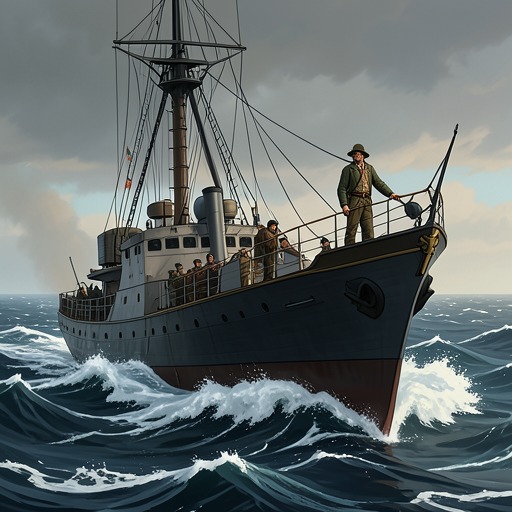
On the morning of 25 September 1943, the Caine and the Moulton lay together in the far corner of West Loch, a narrow inlet of Pearl Harbor. The Moulton was secured fore and aft to buoys, while muddy shallows hemmed in the ships ahead, astern, and to starboard. Only a few hundred yards of dredged channel offered the Caine room to maneuver out. Queeg, brisk and smiling, inspected the lines before ordering them taken in; then he ordered the engines astern at one-third power.
The narrow space made the departure a test of precise handling, with the Moulton immediately exposed to the Caine’s movement. As the Caine backed, its sharp anchor fluke tore along the Moulton’s forecastle, bending several stanchions and ripping two from their roots. The anchor then gashed the Moulton’s bridge. At the same time, a gun on the Caine’s galley deckhouse scraped along the other ship’s side, carrying away two ammunition boxes and an antenna, which fell into the water. The damage was not merely a near miss: the new captain’s first maneuver had injured the ship beside him.
Collision and Grounding
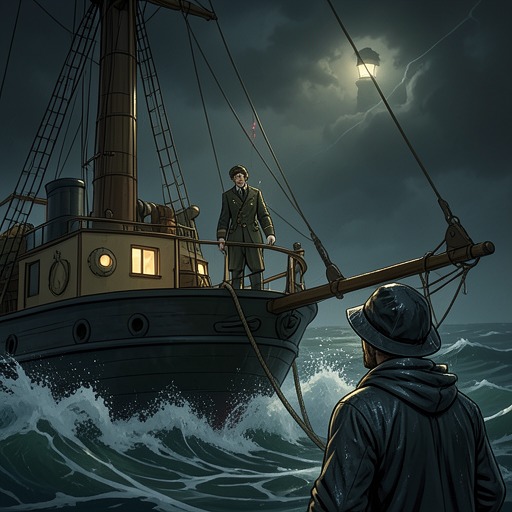
The departure rapidly became confused. Queeg shouted a tangle of engine and steering orders; black smoke poured from the Caine’s stacks across the bridge, while men yelled and ran through the smoky gloom. Willie Keith, on the bridge as junior officer of the deck, could not tell exactly what had gone wrong or why. The Caine ended up stuck by the stern in mud on the other side of the loch, canted about ten degrees.
In the shocked quiet afterward, Queeg appeared less disturbed than the others. He sent Burt Gorton aft to inspect for damage and used a blinker to apologize to Captain Sammis. Gorton reported no visible damage to the Caine’s hull, but the propellers were buried in mud to their hubs. That limited finding did not erase the damage inflicted on the Moulton or the fact that the Caine had run aground; the scene places the mishap’s several consequences side by side rather than treating an intact hull as proof that nothing significant happened.
Refloating and Delayed Reporting
When Gorton raised the need to send a grounding report to ComServPac, Queeg did not authorize one. Instead, he directed Gorton to signal a tug visible near the point. The tug came into West Loch, a towline was rigged, and the Caine was pulled easily off the mud. Queeg thanked the tug captain and treated the immediate crisis as finished. He then dismissed the proposed report, reasoning that higher authority need not be stirred over an incident that help had resolved.
That choice did not keep the grounding from reaching ComServPac. A tug involved in the rescue reported what had happened, and the command subsequently requested a formal account. Queeg’s response exposed the difference between keeping the incident off the record and controlling how it would appear on the record: once a report could no longer be avoided, he prepared one that reduced the mishap and redirected responsibility.
The Official Account
The report identified the event as the grounding of the USS Caine (DMS 22) in West Loch on 25 September 1943. It gave the grounding time as 0932 and stated that the Caine was floated off by YT 137 at 1005. It described the vessel as only slightly aground and declared that there had been no casualties or damage. The statement that there was no damage sits uneasily beside the scene’s account of the Moulton’s damaged forecastle and bridge, lost ammunition boxes, and antenna carried into the water; Gorton’s earlier report concerned the absence of visible damage to the Caine’s hull.
The report attributed the grounding to the engine room’s failure to respond promptly to orders telegraphed from the bridge. Willie had been unable to determine what had gone wrong during the confusion, so the official explanation offered a certainty that his immediate experience had not supplied. The report also presented Queeg’s command as newly relieved and its crew’s training as inadequate, claiming that a drastic drilling program had already begun and would quickly prevent a recurrence. In this account, the mishap becomes both an engine-room failure and an occasion to justify Queeg’s training regime.
The document explained the absence of an immediate dispatch by saying that assistance was at hand, damage was nil, and the matter had seemed too minor to trouble higher authority unnecessarily; it expressed regret if that judgment had been mistaken. Queeg sent Willie to deliver the report by hand. On the journey, Willie’s curiosity overcame his reluctance: he opened the envelope and read the account. The sequence makes the report’s arrival a second stage of the event. What began as an uncontrolled maneuver and a public collision was followed by a carefully framed written version that assigned blame, emphasized the new captain’s corrective program, and defended the delay in reporting.
Significance
The grounding introduces the gap between what happens aboard the Caine and what its commander is willing to communicate about it. The collision is concrete and witnessed; the Caine is visibly stranded, the Moulton is damaged, and a tug must pull the ship free. Yet the official document minimizes damage, attributes the cause to the engine room, and treats Queeg’s response as evidence of a program to improve the crew. The contrast gives the incident consequences beyond the brief interruption of the ship’s departure: it establishes that command authority can shape not only a response to failure but also the written account by which others will judge it.
Willie’s role links the two versions without making him an investigator who can resolve the cause. He witnesses the confusion but cannot tell what went wrong; later, carrying the sealed report, he reads the captain’s explanation for himself. The episode therefore introduces him to the distance between observed events and official narration at the same time that it begins Queeg’s record of command aboard the Caine.